Initial HTML content
Inspect the signal in the rendered page.

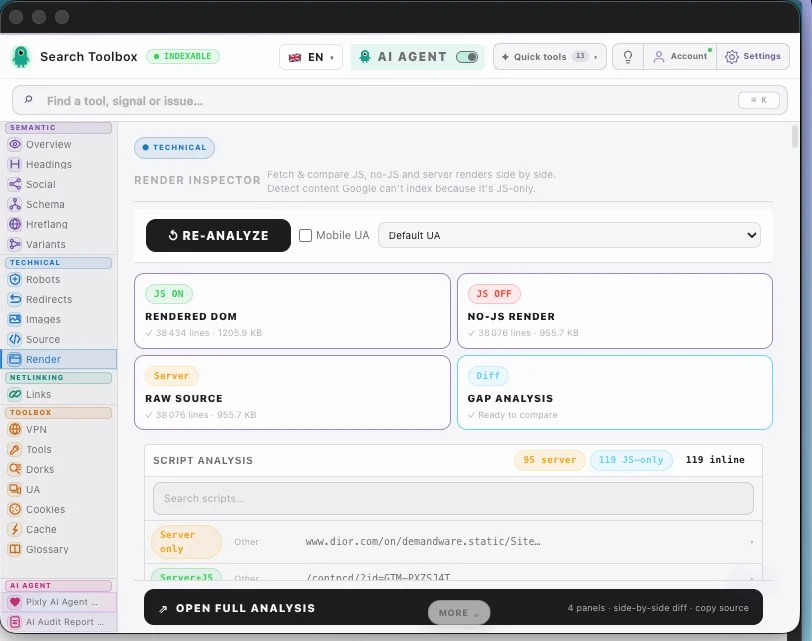
Search Toolbox helps you compare the first server response with the final page state, directly on the live page. The goal is a reproducible diff and a precise development ticket, without hiding the evidence behind one overall score.
JavaScript SEO specialists and frontend teams
Learn SEO / GEO the practical way
A guided route from first observation to verification. Open the lesson to learn the method, or jump to its tool and inspect the active page.
Start on the live URL and record the final URL, HTTP response and indexability.
Resolve noindex, title, description, robots and canonical conflicts first.
Read the hierarchy, follow internal anchors and fix repeated image-template errors.
Inspect the rendered JSON-LD graph, required properties and conflicting entities.
Test reciprocity, language codes, canonicals and HTTP status across the cluster.
Follow every hop and confirm the final URL is indexable and self-canonical.
Learn what the server sends, what JavaScript adds and which differences deserve investigation.
Use this deeper check only when simpler panels reveal a JavaScript-related contradiction.
Turn evidence into an ordered plan, change one thing, then rerun the same checks.
What you can verify
Inspect the signal in the rendered page.
Compare source code with the browser output.
Find contradictions that block indexation.
Export evidence your team can act on.
The observable problem
The useful outcome
The note written after the third coffee
“View source is the page’s baby photo; the rendered DOM is what turned up to the meeting. When they disagree, search engines have to decide which version they actually met.”
Evidence on the real page

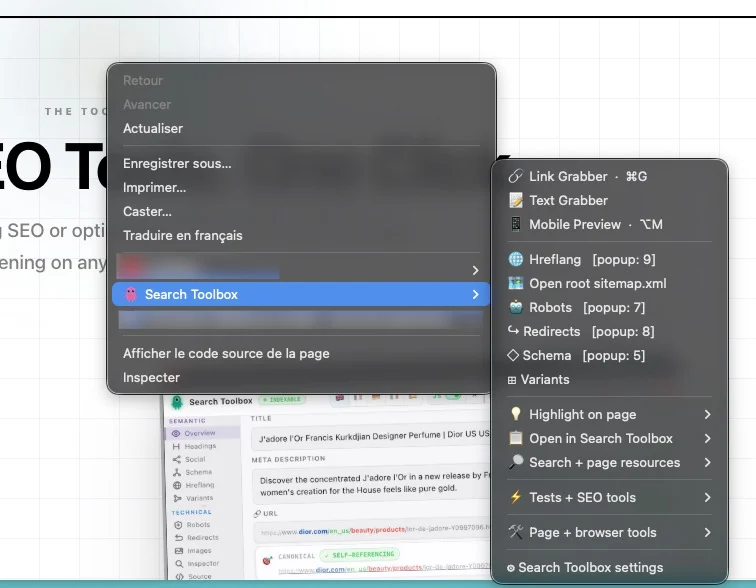
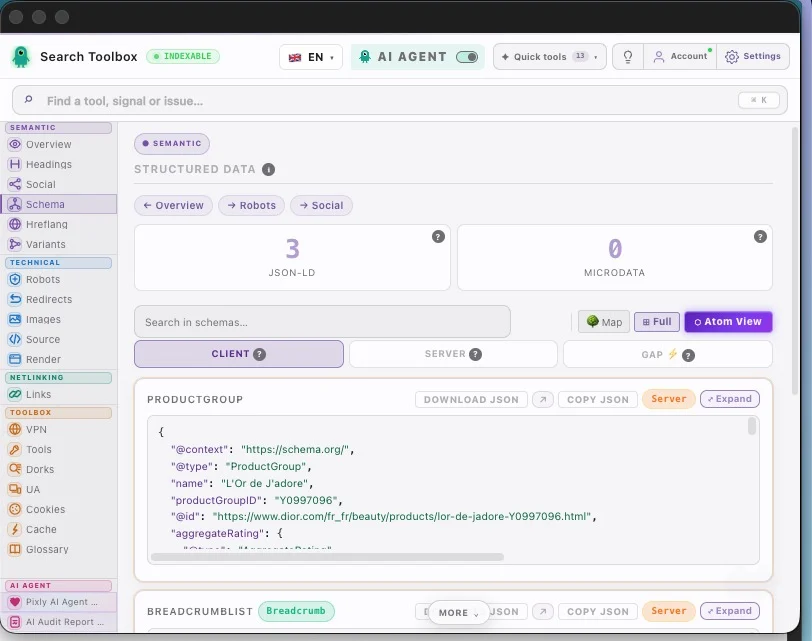
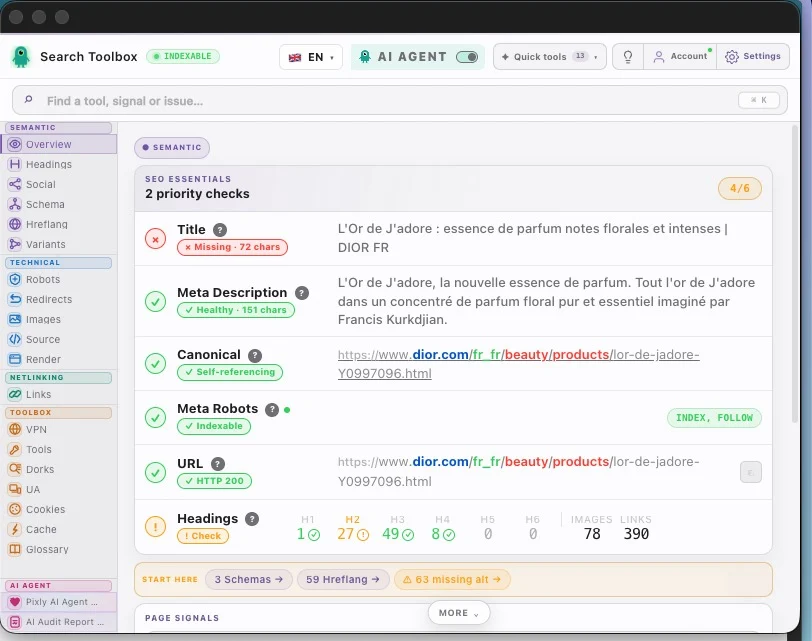
Check the source HTML vs rendered DOM in the real session, staging environment or localhost — preferably the troublesome page, not the perfectly groomed demo.
Check initial html content, hydrated dom changes, metadata and canonical mutations, injected links and schema and connect signals that contradict each other.
Aim for a reproducible diff and a precise development ticket. Change one rule at a time, then repeat the exact same check so you know what actually moved.
For the source HTML vs rendered DOM, Search Toolbox inspects the active URL deeply. It is not a full-site crawler, backlink platform or rank tracker. Test several URLs when the issue comes from a template.
It covers initial html content, hydrated dom changes, metadata and canonical mutations, injected links and schema to deliver a reproducible diff and a precise development ticket.
Manual checks for the source HTML vs rendered DOM are included in the 60+ free tools. Only the optional contextual SEO Expert uses credits.
Yes. The source HTML vs rendered DOM check runs on the page you are viewing, including logged-in sessions and non-public environments.
For the source HTML vs rendered DOM, Search Toolbox inspects the active URL deeply. It is not a full-site crawler, backlink platform or rank tracker. Test several URLs when the issue comes from a template.
Manual checks for the source HTML vs rendered DOM are included in the 60+ free tools. Only the optional contextual SEO Expert uses credits.