Hreflang reciprocity by market
Inspect the signal in the rendered page.

Search Toolbox helps you verify that every market receives the correct indexable product or category URL, directly on the live page. The goal is a reciprocal, canonical and locally relevant product cluster for every market, without hiding the evidence behind one overall score.
international ecommerce teams, marketplaces and migration owners
What you can verify
Inspect the signal in the rendered page.
Compare source code with the browser output.
Find contradictions that block indexation.
Export evidence your team can act on.
The observable problem
The useful outcome
CMS problems to diagnose
International catalogs combine language, country, currency, inventory and product data. A valid tag on the starting page is not enough: Search Toolbox helps verify the whole market relationship from the live URLs.
What you observe
A localized URL lists all alternatives but canonicalizes to the global store or a redirected parameter version.
Inside Search Toolbox
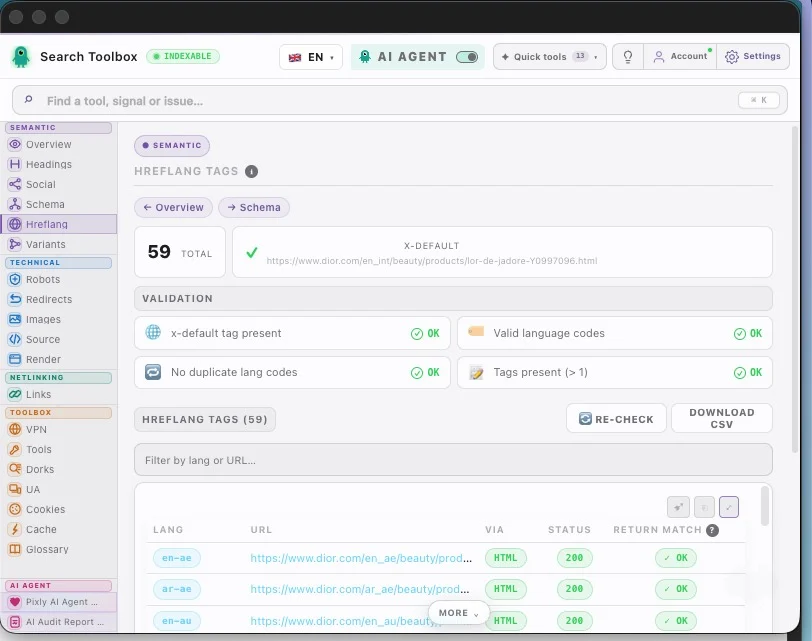
Open Hreflang and Overview on every market target. Check 200, reciprocal returns and self-canonical together.
The useful decision
Align canonical and hreflang around one indexable URL per market before expanding the cluster.
What you observe
Bots or users can be forced to another country, homepage or unavailable-product route, breaking the intended market URL.
Inside Search Toolbox
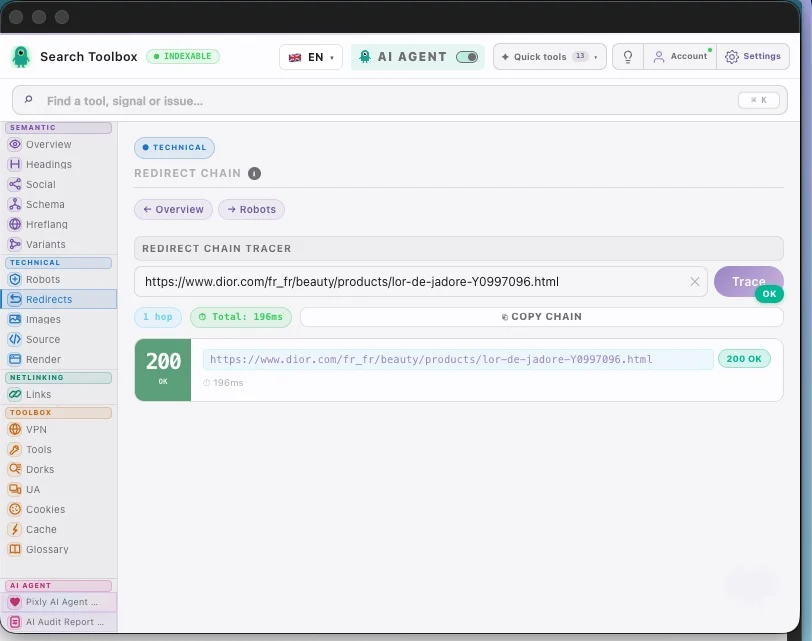
Use Redirects with normal and crawler user agents. Record every hop and the final canonical.
The useful decision
Offer a market choice instead of an unavoidable redirect when possible, and preserve deep product URLs.
What you observe
Visible price, availability and currency can differ from Product schema, translated title or Open Graph data after a market switch.
Inside Search Toolbox
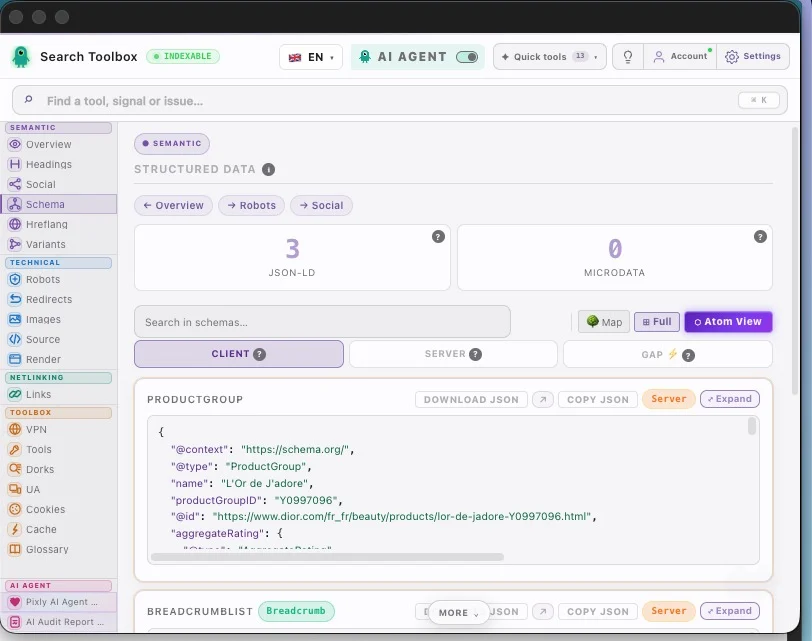
Compare Overview and Schema for the same SKU in at least three markets. The rendered values must describe what the shopper sees.
The useful decision
Use one market-aware data source for visible content and structured data, then retest after currency or stock changes.
From finding to strategy
A compact matrix exposes template and market-rule failures faster than crawling thousands of localized URLs without context.
Select one category, one standard product, one variant product and one unavailable product across three priority markets.
Record status, redirect path, canonical, hreflang, visible price and Product schema for every cell.
Fix one rule at template or market level, then repeat the identical matrix before rollout.
Guides to open during this audit
Open the real page, run the named checks and keep before-and-after evidence. That is more useful than a score turning green without saying why.
Install for freeEvidence on the real page

Check the international ecommerce SEO audit in the real session, staging environment or localhost — preferably the troublesome page, not the perfectly groomed demo.
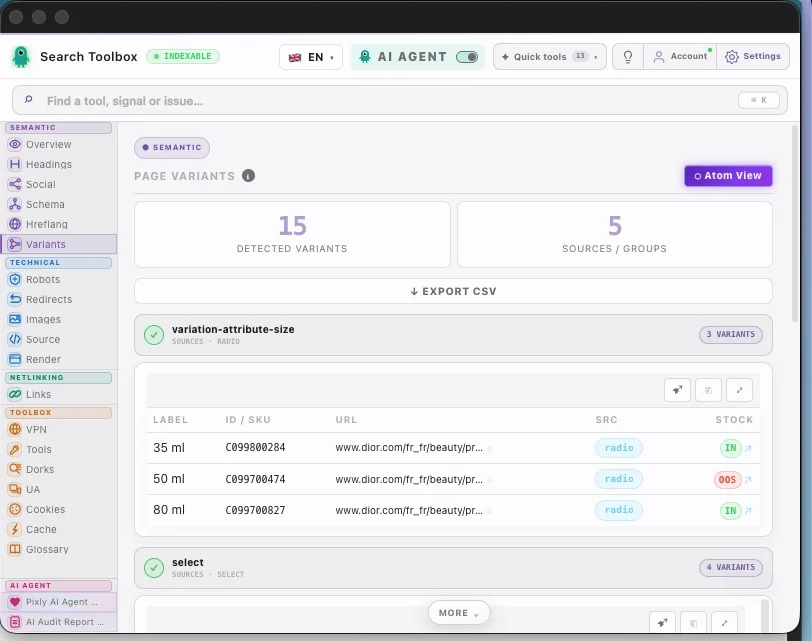
Check hreflang reciprocity by market, regional canonical targets, currency and inventory variants, product schema and redirects and connect signals that contradict each other.
Aim for a reciprocal, canonical and locally relevant product cluster for every market. Change one rule at a time, then repeat the exact same check so you know what actually moved.
For the international ecommerce SEO audit, Search Toolbox inspects the active URL deeply. It is not a full-site crawler, backlink platform or rank tracker. Test several URLs when the issue comes from a template.
It covers hreflang reciprocity by market, regional canonical targets, currency and inventory variants, product schema and redirects to deliver a reciprocal, canonical and locally relevant product cluster for every market.
Manual checks for the international ecommerce SEO audit are included in the 60+ free tools. Only the optional contextual SEO Expert uses credits.
Yes. The international ecommerce SEO audit check runs on the page you are viewing, including logged-in sessions and non-public environments.
For the international ecommerce SEO audit, Search Toolbox inspects the active URL deeply. It is not a full-site crawler, backlink platform or rank tracker. Test several URLs when the issue comes from a template.
Manual checks for the international ecommerce SEO audit are included in the 60+ free tools. Only the optional contextual SEO Expert uses credits.